While the people of Israel were still at Rephidim, the warriors of Amalek attacked them. Moses commanded Joshua, “Choose some men to go out and fight the army of Amalek for us. Tomorrow, I will stand at the top of the hill, holding the staff of God in my hand.”
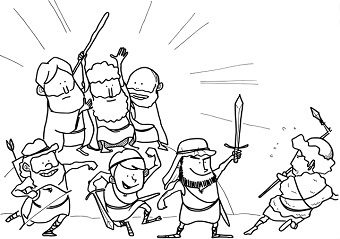
So Joshua did what Moses had commanded and fought the army of Amalek. Meanwhile, Moses, Aaron, and Hur climbed to the top of a nearby hill. As long as Moses held up the staff in his hand, the Israelites had the advantage. But whenever he dropped his hand, the Amalekites gained the advantage. Moses’ arms soon became so tired he could no longer hold them up. So Aaron and Hur found a stone for him to sit on. Then they stood on each side of Moses, holding up his hands. So his hands held steady until sunset. As a result, Joshua overwhelmed the army of Amalek in battle.
After the victory, the Lord instructed Moses, “Write this down on a scroll as a permanent reminder and read it aloud to Joshua: I will erase the memory of Amalek from under heaven.” Moses built an altar there and named it Yahweh-Nissi (which means “the Lord is my banner”). He said, “They have raised their fist against the Lord’s throne, so now the Lord will be at war with Amalek generation after generation.” – Exodus 17:8-16 NLT
Earlier in chapter 17, the Israelites had learned how God provided water for them. Now, they’ll have to learn to trust God to bring about the defeat of their hostile neighbours.
The role Moses, Aaron and Hur played in the battle against the Amalekites and in ensuring total victory, is very important and cannot be overemphasised.
The posture Moses took on top of the hill could be any of two possibilities. It could be one resembling a warlike gesture with his arms and staff raised. It could also have been symbolic of prayer and intercession or both.
Although the scriptural text did not specifically say Moses explicitly prayed, we can assume his posture typifies that of one who is praying. With Moses’ raised arms, it symbolised the raising up of Jehovah God, as their banner of military strength and power.
Their roles indicate that we have a great and awesome testimony to the efficacy and power of intercessory prayer.
The dropping of Moses’ hands proved that he was human. As Christians, sometimes we get tired and get weary spiritually. We need to understand that we cannot do it all alone, we need the support and help of fellow believers.
That’s why it’s so important that we belong to a Church family. We will sometimes struggle with life issues and our hands of prayer (and resources) will be tired and hanging down. Thank God we have the church to turn to support us in lifting up of hands of prayer, counsel and resources.
God often uses willing human instruments to accomplish His purposes. The victory over the Amalekites is entirely attributable to the power of God as the great General and Warrior. God, however, needed the skills of Joshua, the willingness of the army, and the intercession of Moses and his associates.
Joshua and his army trusted God and fought, Moses and his associates trusted God and interceded, and God did the rest!
This is how we grow in faith and God’s name is lifted high, exalted and glorified.
Stay blessed,
LaraLex
 Hills and Valleys