While the people of Israel were still at Rephidim, the warriors of Amalek attacked them. Moses commanded Joshua, “Choose some men to go out and fight the army of Amalek for us. Tomorrow, I will stand at the top of the hill, holding the staff of God in my hand.”
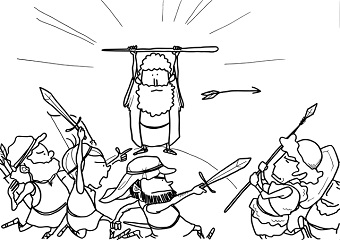
So Joshua did what Moses had commanded and fought the army of Amalek. Meanwhile, Moses, Aaron, and Hur climbed to the top of a nearby hill. As long as Moses held up the staff in his hand, the Israelites had the advantage. But whenever he dropped his hand, the Amalekites gained the advantage. Moses’ arms soon became so tired he could no longer hold them up. So Aaron and Hur found a stone for him to sit on. Then they stood on each side of Moses, holding up his hands. So his hands held steady until sunset. As a result, Joshua overwhelmed the army of Amalek in battle.
After the victory, the Lord instructed Moses, “Write this down on a scroll as a permanent reminder and read it aloud to Joshua: I will erase the memory of Amalek from under heaven.” Moses built an altar there and named it Yahweh-Nissi (which means “the Lord is my banner”). He said, “They have raised their fist against the Lord’s throne, so now the Lord will be at war with Amalek generation after generation.” – Exodus 17:8-16 NLT
The Amalekites were descendants of Esau, Jacob’s twin brother. Amalek was the grandson of Esau. The unprovoked attack on the Israelites points to a historic origin of the enmity and hostility (see Genesis 27). The Amalekites were the first to attack the Israelites after the exodus. They were a thorn and remained a threat to Israel for many years.
In the Bible, naming an altar has a special significance. It marks and celebrates a characteristic of God that was associated with the act or worship there and serves as a remembrance of His great deeds. Moses acknowledged God as the main source of Israel’s victory. In short, God Himself was the banner under which the Israelites fought and won the battle.
It is worth mentioning that the Israelites were not trained fighters. These are shepherds and people who have been under slavery for many years. The Amalekites on the other hand were nomadic people, seasoned, and trained warriors.
As Joshua and his fighters saw Moses standing on top of the hill with his hand raised, they must have been full of encouragement and confidence. They must have found renewed strength and vigour to push back the Amalekites.
The Israelite army was inexperienced and overmatched but they were never the underdogs. They did not go to the battle alone. The LORD, our banner, the Great Warrior and General was with them.
Moses named the altar, “The LORD Is My Banner.” This serves as a remembrance of God’s greatness, provision, His faithfulness as a covenant promise keeper. The altar also serves as a celebration of victory, an expression of gratitude and thanks. Moses was making a declaration; one we can certainly identify with and follow today.
In the next blog, we will explore the significance of Aaron and Hur’s role in the victory.
Stay blessed,
LaraLex
 Hills and Valleys